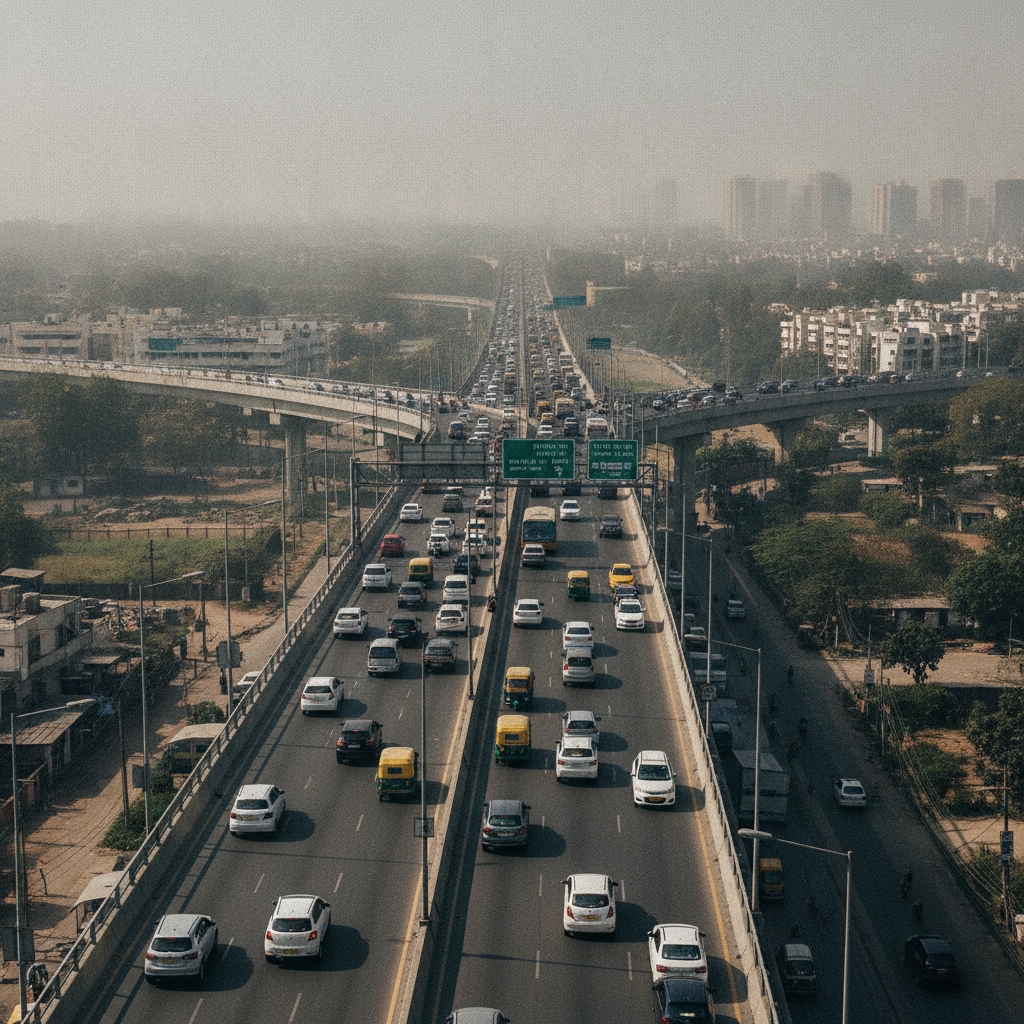
Heavy Monsoon Rains Submerge Noida Roads and Trigger Regional Red Alert

Heavy monsoon rains lashed Noida this week, submerging roads and disrupting traffic after a dramatic weather shift from extreme heat to relentless rainfall. The India Meteorological Department (IMD) issued a red alert for the region, warning of continued heavy rainfall accompanied by thunderstorms and lightning.
The sudden downpour caused severe waterlogging across Noida, leaving commuters to navigate flooded streets. The impact was felt across the wider National Capital Region (NCR), with neighboring Ghaziabad's Indirapuram and Abhay Khand areas experiencing extensive waterlogging that forced commuters to wade through knee-deep water. In Delhi, the overnight rain uprooted trees, damaged vehicles, and led to the collapse of a four-storey under-construction building in Rohini, which killed three people.
Weather experts stated that the dramatic turnaround from the oppressive heat experienced ten days prior was caused by the rare convergence of multiple weather systems. An active Western Disturbance, the southwest monsoon, a low-pressure area over central India, and a northward shift of the monsoon trough all aligned simultaneously over northern India.
Krishna Mishra, a scientist at the IMD, explained that the interaction of the Western Disturbance, the monsoon trough, and a weakening depression released enormous amounts of moisture into the atmosphere. This alignment caused widespread rainfall across Noida, Delhi, Haryana, Punjab, and Uttar Pradesh.
Mahesh Palawat of Skymet Weather noted that the continuous rainfall resulted from the interaction of a Western Disturbance over northern Pakistan, an intense low-pressure area over central Madhya Pradesh, and moisture-laden monsoon winds from the Arabian Sea. Instead of acting independently, these systems reinforced one another.
The IMD also attributed the persistent rain to the seasonal monsoon trough shifting northwards from central India towards the Himalayan foothills. As the trough moved closer to the region, it concentrated moisture, allowing rain-bearing clouds to develop repeatedly.
During the 24-hour period ending Thursday morning, Safdarjung recorded 72.6 mm of rain, while Lodhi Road received over 80 mm. The IMD, which classifies rainfall above 64.4 mm in 24 hours as heavy, indicated that the wet spell is likely to continue until the interacting weather systems weaken and shift further north.