Design Flaws on New Barapullah Phase-III Corridor Cause Widespread Traffic Chaos
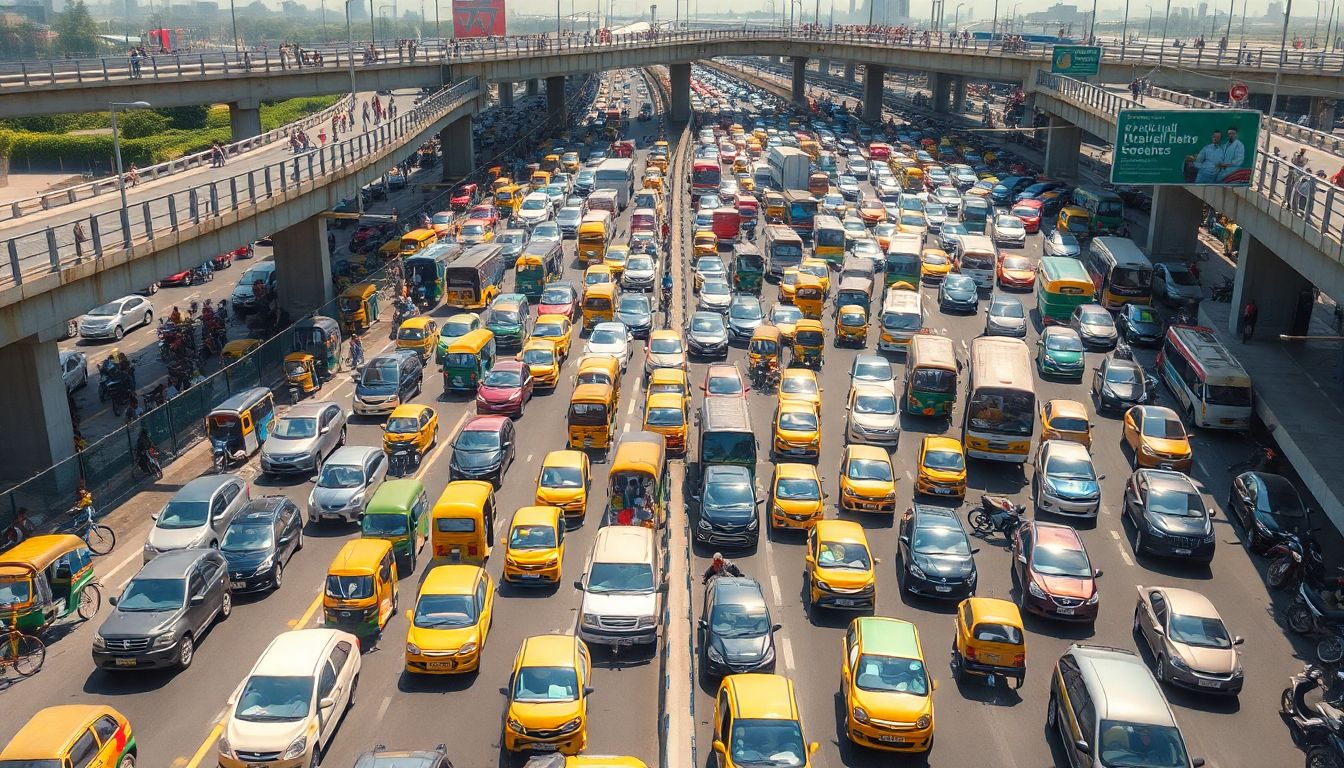
Within two days of opening, the newly launched Barapullah Phase-III elevated corridor connecting Mayur Vihar to the existing elevated network has triggered severe congestion across south and east Delhi, prompting Delhi Traffic Police to conduct aerial drone surveys that flagged major design flaws. The new corridor drew substantial vehicular volumes that would otherwise have travelled through National Highway 24 and the Delhi-Noida Direct flyway, funneling vehicles into bottlenecks where multiple lanes abruptly merge into fewer lanes.
The aerial survey conducted after two days of near-continuous congestion identified two primary structural problems. At several points, two sets of three lanes merge into a three-lane corridor, effectively squeezing six lanes of moving traffic into three. At another point, where traffic from the new Mayur Vihar spur meets the existing flyover on the loop over Sundial Park, a lane ends abruptly at nearly a 90-degree angle, creating severe vehicular conflict.
Additional Commissioner of Police for Zone-II Traffic Dinesh Kumar Gupta stated that the drone survey revealed three lanes of packed traffic from Mayur Vihar merging with three lanes from the Sundial loop into a corridor that is only three lanes wide, leading to complete deadlock. To manage the movement, traffic police proposed installing an additional traffic signal directly on the elevated corridor at the merger point. If implemented, this would make Barapullah one of the few elevated corridors in the country requiring two traffic signals. Police also requested the Public Works Department to install barricades at the junction to alter the geometry and enforce a gradual merge.
Experts warned that traffic management alone cannot resolve flawed road design. S Velmurugan, former chief scientist and head of the traffic engineering and safety division at the Central Road Research Institute, noted that merging six lanes into three will always produce bottlenecks. He observed that auxiliary lanes were poorly designed, leading to sudden vehicle merges, and stressed that proper signage, road markings, and gore area treatments using reflective paint, bollards, and solar studs are urgently required.
The disruption extended well beyond the corridor, spilling onto the Ring Road, Outer Ring Road, Mathura Road, Bhairon Marg, Sarai Kale Khan, and towards ITO. On Thursday evening ahead of the long weekend, the eight-kilometre route from Safdarjung Hospital to Sarai Kale Khan exceeded an hour, while the signal-free trip between the AIIMS flyover and Sarai Kale Khan took over 45 minutes. Commuter Karan Singh, a Ghaziabad resident rerouted towards Bhairon Marg, said his usual 45-minute commute increased to over two hours.
Traffic police noted that the gridlock was further aggravated by ongoing construction work at Chirag Delhi, Modi Mill flyover, and stretches between South Extension and Ashram junction, along with an IIT-Delhi college festival on the Outer Ring Road and a broken-down bus near Ashram.