Delhi Master Plan 2047 Sets Two-Pronged Strategy for 32 Million Residents
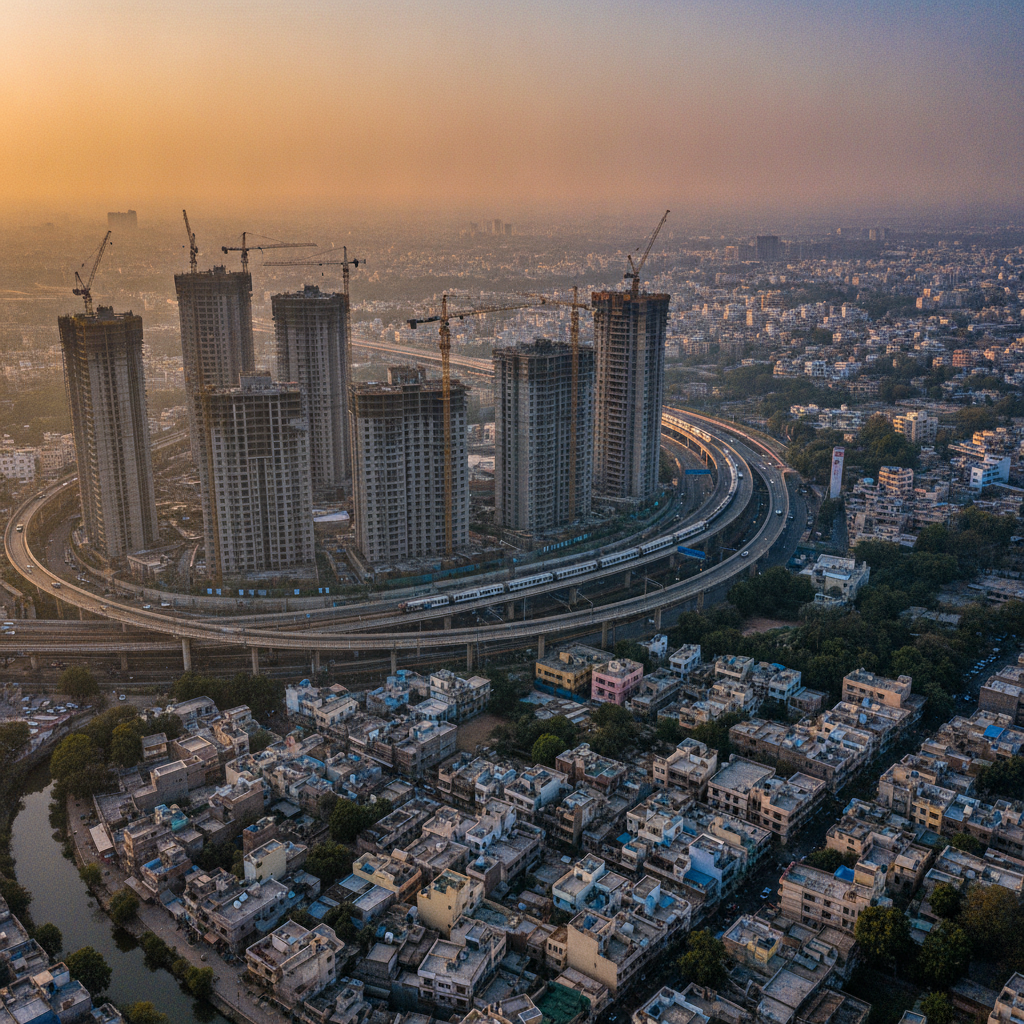
The Union government is expected to notify the Delhi Master Plan 2047 this week, outlining a two-pronged growth strategy to redevelop existing built-up areas and open new planned urban extensions to accommodate a projected population of nearly 32 million people.
The plan, approved by the Delhi Development Authority (DDA) last week, focuses on rebuilding existing neighbourhoods, regenerating unauthorised colonies, and developing denser, infrastructure-led urban extensions. It proposes higher floor area ratios (FAR) to support the estimated four million new houses required for the capital's growing population.
Under the master plan, development is linked directly to the availability of essential public utilities, such as roads, public transit, sewerage, electricity, and digital connectivity. The DDA adopted this infrastructure-first approach to address previous expansion setbacks, such as housing projects in Narela and Bawana that faced tepid responses from buyers and residents due to a lack of essential civic infrastructure.
The plan highlights Delhi's ageing planned residential areas—including cooperative housing societies, DDA colonies, plotted developments, resettlement colonies, rehabilitation colonies, government housing, and private group housing—as primary sources of additional housing capacity. To maximize land use in these already serviced locations, the framework allows properties to be pooled and reorganised under Road Network Plans prepared alongside local bodies and residents.
In an illustrative model for planned residential areas, the plan increases the FAR to 300 from the existing 150 to 200 range, caps ground coverage at 30 percent, sets green or open areas at 30 percent, and permits building heights up to G+9. For general regeneration schemes, the framework allows a maximum FAR of 1.5 times the base FAR alongside plot amalgamation.
The densification strategy also covers unplanned settlements. Unauthorised colonies can undergo regeneration on plots of at least 2,000 square metres with a base FAR of 350 and ground coverage between 40 and 50 percent. For urban villages, the plan proposes area improvement plans, road widening, and the rejuvenation of water bodies. For slum and jhuggi-jhopri clusters, the strategy outlines an in-situ rehabilitation model permitting an FAR of 500 for both rehabilitation and remunerative components.